اخبار
صفحه اصلی / اخبار / اخبار صنعت / Seawater RO Membranes: How They Work, What to Look For, and How to Keep Them Running
Seawater RO membranes — short for seawater reverse osmosis membranes — are the core filtration elements in desalination systems that convert raw seawater into fresh, drinkable water. They work by forcing pressurized seawater through an extremely thin semi-permeable membrane layer that allows water molecules to pass through while blocking dissolved salts, minerals, bacteria, viruses, and other contaminants. The clean water that passes through the membrane is called permeate, while the concentrated salt-laden water that doesn't pass through is called brine or concentrate, which is discharged back to the sea or treated further.
Seawater typically contains between 33,000 and 45,000 parts per million (ppm) of total dissolved solids (TDS), primarily sodium chloride. This is dramatically higher than brackish water (1,000–10,000 ppm) or tap water, which means seawater reverse osmosis membranes must operate at much higher pressures — typically 55 to 70 bar (800 to 1,000 psi) — compared to brackish water RO systems. This high-pressure requirement places extreme demands on both the membrane materials and the system components surrounding them.
SWRO membranes are used in everything from large-scale municipal desalination plants producing hundreds of thousands of cubic meters of water per day, to offshore oil platforms and ships, to smaller community or hotel water supply systems in water-scarce coastal regions. As global freshwater stress intensifies, seawater RO membrane technology has become one of the most strategically important filtration technologies in the world.
To understand how seawater RO membranes function, it helps to first understand the natural phenomenon they counteract. In normal osmosis, water naturally flows through a semi-permeable membrane from a region of low salt concentration toward a region of high salt concentration, in an attempt to equalize the concentrations on both sides. The pressure driving this natural flow is called osmotic pressure. For seawater, the osmotic pressure is roughly 27 bar (390 psi).
Reverse osmosis reverses this process by applying external pressure greater than the osmotic pressure to the seawater side of the membrane. This forces water molecules to travel in the opposite direction — from the high-salinity seawater side, through the membrane, to the low-salinity permeate side. Because the membrane's pores are approximately 0.0001 microns (0.1 nanometers) in diameter, they are large enough for water molecules (approximately 0.00028 microns) to pass through, but far too small for hydrated sodium, chloride, magnesium, calcium ions, and essentially all biological contaminants to penetrate.
The separation is not 100% perfect — a small fraction of dissolved ions do pass through the membrane, which is why multiple-pass RO systems are sometimes used for applications requiring ultra-pure water. However, a well-performing SWRO membrane typically achieves salt rejection rates of 99.6% to 99.8%, reducing seawater TDS from around 35,000 ppm down to less than 500 ppm in a single pass — well within WHO drinking water guidelines.
Modern seawater reverse osmosis membranes are not simple flat sheets — they are highly engineered composite structures with multiple distinct layers, each serving a specific function. Understanding the structure helps explain both the membrane's performance capabilities and its vulnerabilities.
Almost all commercial seawater RO membranes today use a thin-film composite (TFC) architecture consisting of three layers. The outermost active layer is an ultra-thin polyamide film, typically 50 to 200 nanometers thick, formed by interfacial polymerization between an amine and an acyl chloride monomer on the membrane surface. This polyamide layer is responsible for salt rejection — its crosslinked structure is what determines how tightly ions are excluded.
Beneath the polyamide active layer sits a polysulfone microporous support layer, roughly 40 to 50 micrometers thick. This layer provides mechanical support to the ultra-thin active layer without significantly impeding water flow. The third and bottom layer is a non-woven polyester fabric backing that gives the entire membrane element structural rigidity and allows it to be handled and wound without tearing.
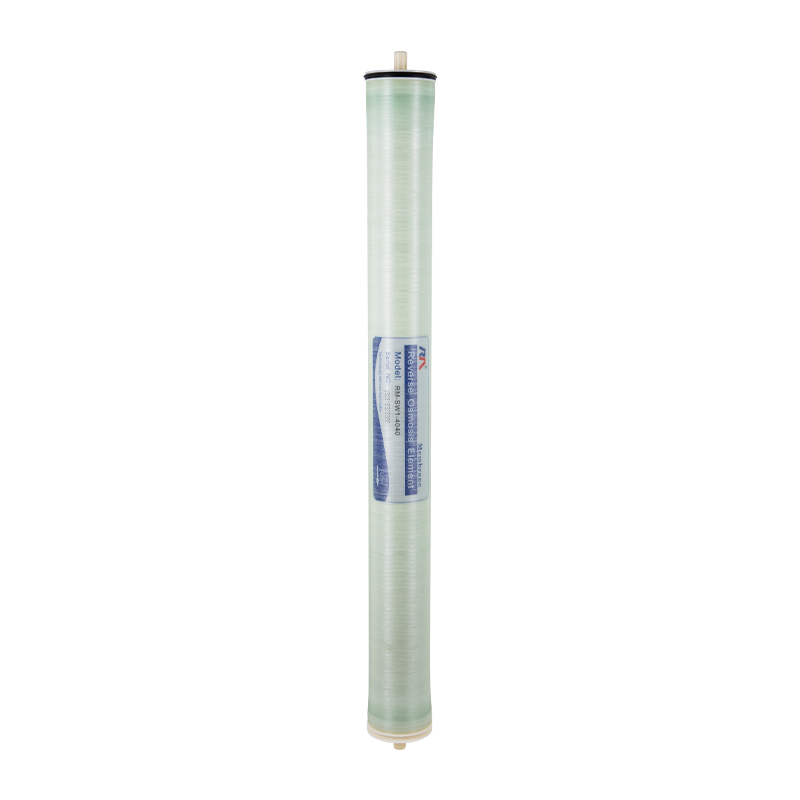
The flat membrane sheets are assembled into spiral wound elements — the dominant commercial configuration for SWRO systems. In a spiral wound element, flat membrane sheets and mesh spacers are layered and then rolled tightly around a central perforated permeate collection tube. Feed water enters the end of the element, flows along the feed spacer channels in a spiral path across the membrane surface, and the permeate spirals inward through the membrane into the central collection tube. Multiple spiral wound elements (typically 6 to 8) are connected in series inside a single pressure vessel to maximize water recovery per housing.
Standard SWRO spiral wound elements come in 8-inch diameter × 40-inch length (8040) format for industrial and large-scale applications, or 4-inch diameter × 40-inch length (4040) format for smaller systems. Each 8040 SWRO element has an active membrane area of approximately 37 to 41 square meters and produces around 20 to 28 cubic meters of permeate per day under standard test conditions.
When evaluating or comparing seawater desalination membranes, these are the critical performance metrics you need to understand:
| Parameter | Typical SWRO Value | What It Means |
| Salt Rejection (%) | 99.6% – 99.85% | Percentage of dissolved salts blocked by the membrane |
| Permeate Flow (m³/day) | 20 – 28 m³/day (8040 element) | Volume of clean water produced per day per element |
| Operating Pressure (bar) | 55 – 70 bar | Feed pressure required to overcome seawater osmotic pressure |
| Water Recovery (%) | 35% – 50% | Percentage of feed water converted to permeate |
| Operating Temperature (°C) | 5°C – 45°C | Acceptable feed water temperature range |
| pH Tolerance | pH 2 – 11 (cleaning); pH 5 – 8 (operation) | Acceptable pH range during operation and chemical cleaning |
| Chlorine Tolerance | <0.1 ppm continuous | Polyamide membranes are damaged by free chlorine |
| Membrane Lifespan | 5 – 10 years | Expected service life under proper operating conditions |
The global market for seawater RO membranes is dominated by a handful of major manufacturers who have invested heavily in polyamide chemistry and membrane engineering. Each offers product lines optimized for different operating conditions and priorities:
Fouling is the accumulation of unwanted material on the membrane surface or within the feed spacer channels, and it is the single biggest operational challenge in seawater reverse osmosis systems. Fouling increases feed pressure requirements, reduces permeate flow, and can permanently damage the membrane if left unaddressed. There are four main categories of fouling in SWRO systems:
Biofouling is the growth of microbial biofilms on the membrane surface and feed spacer. Seawater is inherently rich in bacteria, algae, and other microorganisms — many of which readily colonize membrane surfaces and form dense, gel-like biofilms that obstruct water flow. Biofouling is considered the most challenging fouling type in SWRO because biofilms are difficult to remove once established and can recover quickly after chemical cleaning. Pre-treatment with biocides (sodium hypochlorite followed by dechlorination with sodium bisulfite, since polyamide membranes cannot tolerate free chlorine), UV irradiation, and cartridge filtration is essential to control biological loading on the membranes.
Seawater contains suspended particles — clay minerals, silica colloids, organic matter, and algae cells — that can accumulate on the membrane surface and in the spacer channels, increasing differential pressure across the elements. The Silt Density Index (SDI) and Modified Fouling Index (MFI) are standard tests used to quantify the particulate fouling potential of SWRO feed water. An SDI value below 3 is typically required for stable SWRO membrane operation. Dual-media filtration, ultrafiltration (UF) pre-treatment, or dissolved air flotation (DAF) are commonly used to reduce SDI to acceptable levels before the RO stage.
As seawater is concentrated during the RO process, sparingly soluble mineral salts — primarily calcium carbonate (CaCO₃), calcium sulfate (CaSO₄), barium sulfate (BaSO₄), and silica (SiO₂) — can exceed their solubility limits and precipitate onto the membrane surface as hard scale deposits. Scale is particularly problematic at higher water recovery rates (above 45%) because the brine concentration increases proportionally. Antiscalant chemical dosing into the feed water is the standard method for inhibiting scale formation, with specific antiscalant formulas selected based on the feed water chemistry analysis.
Natural organic matter (NOM) in seawater — including humic acids, proteins, and polysaccharides — can adsorb onto the polyamide membrane surface and cause flux decline over time. Organic fouling is often exacerbated during algal blooms, which significantly increase organic loading in the feed water. Coagulation and flocculation pre-treatment, followed by media filtration or UF, are effective at removing dissolved and colloidal organic matter before it reaches the RO membranes.
When performance monitoring indicates that a membrane train has reached the cleaning trigger points — typically a 15% decrease in normalized permeate flow, a 15% increase in normalized salt passage, or a 15% increase in normalized differential pressure — chemical cleaning in place (CIP) should be performed. The correct cleaning protocol depends on the type of fouling present:
All CIP solutions must be made up using permeate or deionized water — never tap water or raw seawater — to avoid introducing new foulants or contaminants during the cleaning process. After cleaning, the system should be flushed thoroughly before returning to service, and permeate water should be diverted to drain for the first 30 minutes of operation to ensure cleaning chemical residuals are fully purged.
Seawater RO membrane elements are expensive — a single 8040 SWRO element can cost $400 to $900 USD — and replacing an entire large-plant membrane array represents a multi-million dollar expense. Maximizing membrane lifespan through proper operation and proactive maintenance is therefore one of the highest-value activities in SWRO plant management.
Research and development in seawater reverse osmosis membrane technology is intensely active, driven by the need to reduce the energy consumption and cost of desalination as global demand for freshwater continues to rise. Several promising directions are already making their way from the laboratory to commercial products.
Incorporating nanomaterials — including carbon nanotubes, graphene oxide flakes, aquaporin protein channels, and zeolite nanoparticles — into the polyamide active layer can create nanoscale water transport channels that dramatically increase water permeability without sacrificing salt rejection. LG's commercial NanoH2O membrane line was the first to demonstrate this at industrial scale, and multiple other manufacturers are now developing competing nanocomposite SWRO products. Higher permeability means the same amount of water can be produced at lower operating pressure, directly reducing energy consumption and operating costs.
The chlorine sensitivity of conventional polyamide membranes is one of their most significant operational drawbacks, requiring complex dechlorination systems and creating risk of catastrophic membrane damage if those systems fail. Researchers are actively developing alternative membrane polymers — including sulfonated polysulfone, polyimide, and chlorine-resistant polyamide variants — that can withstand continuous low-level chlorine exposure. Commercially viable chlorine-tolerant SWRO membranes would simplify pre-treatment systems and significantly reduce biofouling risk.
Forward osmosis (FO) uses natural osmotic pressure rather than applied mechanical pressure to draw water through a membrane, requiring far less energy than conventional RO. Several pilot and demonstration plants are exploring FO-RO hybrid systems for seawater desalination, where an FO stage partially concentrates and pre-treats the seawater before it enters the RO stage. While not yet cost-competitive with standalone SWRO at large scale, FO-RO hybrid systems show promise for niche applications such as treating very high-salinity brines or integrating with waste heat recovery systems.
The overall trajectory of seawater RO membrane development points toward higher permeability, lower energy consumption, greater fouling resistance, and longer service life — all of which will make desalination increasingly cost-competitive with conventional freshwater sources and help address the growing global water scarcity challenge.